

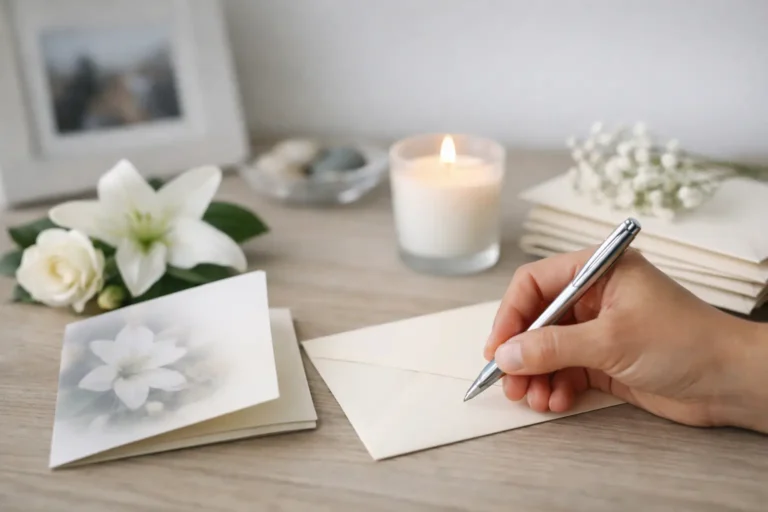
A sympathy card may be small, but the name on the envelope can carry a lot of care. When someone is grieving, a thoughtfully addressed card says, “I’m thinking of you,” before they have even read a word inside. Knowing how to address sympathy cards can take one awkward detail off your plate, so you can focus on sending comfort.
There is no need to make the envelope overly formal or perfect. The best choice is usually the one that feels most respectful of the person, their family, and your relationship with them. A simple card, a clear name, and a sincere message are more than enough.
How to Address Sympathy Cards for One Person
If you are writing to one person who has lost a loved one, address the envelope directly to them using the name you normally use in conversation. For a close friend, “Sarah Johnson” is warm and natural. If your relationship is more formal, use a title such as “Mrs. Sarah Johnson” or “Dr. Sarah Johnson.”
Inside the card, the greeting can be just as simple: “Dear Sarah,” “Dear Mrs. Johnson,” or “Sarah, I was so sorry to hear your news.” Match the level of formality to the relationship rather than trying to follow a strict rulebook.
If the recipient has a name or title you are unsure about, it is better to check than guess. Getting their name right is a quiet but meaningful sign of respect.
Addressing a Card to a Couple or Family
When a loss affects an entire household, it is completely appropriate to send one sympathy card to the family. On the envelope, you can write “The Martinez Family” or “David and Elena Martinez.” This works especially well after the loss of a parent, child, sibling, or another relative who was loved by everyone in the home.
For a more personal approach, address the card to the person you know best while acknowledging the family inside. For example, the envelope might read “Elena Martinez,” while the message begins, “Dear Elena and family, I’m holding you all in my thoughts.”
If you know the names of multiple grieving family members, include them when it feels appropriate. “To James, Priya, and the Patel family” feels caring without requiring a separate card for every person. It depends on the situation: immediate family members may appreciate individual notes, while a shared family card can be the kindest option when you do not know everyone well.
When the Person Who Died Is Named on the Card
Avoid addressing the envelope to the person who has died. Instead, send the card to the surviving spouse, partner, parent, adult child, or closest family contact.
You can, of course, mention the person who died inside the card. Using their name often makes your message feel more personal. Rather than writing only, “I’m sorry for your loss,” you might write, “I’ll always remember how warmly Michael welcomed everyone into his home.” A specific memory can be a lovely gift, especially when words are hard to find.
Sympathy Card Etiquette for Coworkers and Professional Contacts
Work relationships can make sympathy card wording feel a little tricky. If you are sending a card from one colleague to another, use the name they use at work. “Dear Jordan” is often the right balance of professional and personal.
If an entire team is signing one card, address it to the grieving colleague only. Inside, a group message such as “Thinking of you and your family during this difficult time” is thoughtful and suitable. Each person can add a short signature or a personal line if they knew the family member.
For a client, teacher, manager, or professional acquaintance, a respectful title may be the better choice. “Dear Dr. Williams” or “Dear Ms. Chen” keeps the note considerate without sounding distant. Do not worry about finding a grand statement. A few genuine words are enough.
What to Write on the Envelope
The envelope itself should stay clean and simple. Use a readable pen, write the full mailing address clearly, and include your return address. The return address matters more than people sometimes realize. During a busy, emotional time, it helps the recipient know who sent the card even if an envelope gets separated from its contents.
A plain envelope is always appropriate, but gentle stationery can feel especially thoughtful. Soft florals, calming colors, or an understated illustrated design can offer warmth without making the moment feel cheerful in the birthday-card sense. For sympathy occasions, choose a design that supports the message rather than competing with it.
Skip playful stickers, glitter-heavy decorations, or bright party-style envelopes unless you are completely sure the recipient would appreciate that kind of personal touch. This is one of those moments where less is usually more.
Should You Use “Mr. and Mrs.”?
Traditional forms like “Mr. and Mrs. Thomas Reed” are still acceptable for people who use them, particularly for older relatives or formal family friends. But they are not required. Many people prefer their own first and last names to be written separately, such as “Thomas and Angela Reed.”
Use the names that reflect how the recipients identify themselves. For unmarried couples, write both full names on separate lines if needed. For same-sex couples, follow the same simple approach: use each person’s name, or address the card to the family name if that is how they refer to their household.
Thoughtfulness is the etiquette. The goal is not to perform perfect formality. It is to make the recipient feel seen.
If You Don’t Know the Family Well
You may be sending a card to a neighbor, a friend’s parent, a coworker’s family, or someone in your community. In that case, a formal but warm address is a safe choice. “Dear Mr. and Mrs. Davis” or “To the Davis Family” works well.
Inside, keep the note sincere and uncomplicated. You do not need to explain why you are reaching out or worry that your words are not profound enough. “I was very sorry to hear about your loss. Please accept my heartfelt condolences,” is a caring message from someone who wants to show support.
If you heard about the death through someone else, do not include details that may be inaccurate. It is kinder to keep the focus on your sympathy and support.
Timing Matters Less Than You Think
Send a sympathy card as soon as you can, but do not let a missed week stop you. Grief does not end after the funeral, and a card that arrives later can be a welcome reminder that someone still cares.
If several weeks or months have passed, acknowledge it gently. You might write, “I’ve been thinking of you and wanted you to know I’m still holding you in my heart.” A card sent on a birthday, anniversary, holiday, or other difficult milestone can also mean a great deal.
At Gooji Paperie, we believe paper goods help people show up for each other, whether the message is joyful, funny, grateful, or tender. In a hard moment, the most meaningful card is not the fanciest one. It is the one that arrives with care, carries your real voice, and reminds someone they do not have to feel alone.
