

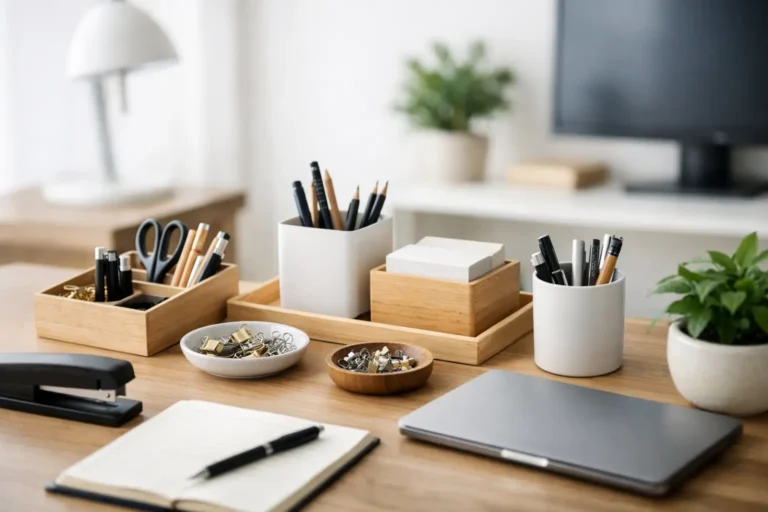
A desk can go from productive little creative hub to mystery pile in a single busy week. One pen rolls behind the monitor, sticky notes multiply, and suddenly the scissors you need for a birthday card are nowhere to be found. The good news: learning how to organize desk supplies does not require a matching set of 27 containers or a full Saturday afternoon. It just takes a setup that makes sense for the way you actually work, study, plan, and create.
The goal is not a desk that looks untouched. A useful desk should have personality, a favorite notebook within reach, and room for real life. The trick is giving every supply a clear home so you can get back to writing, making lists, packing party favors, or sending a thoughtful note without the frantic rummaging.
Start by Organizing Desk Supplies Into Zones
Before buying a single desk organizer, clear a small working area and look honestly at what is sitting there. Not everything belongs on your desktop. Some items are daily essentials, some are occasionally useful, and some may be empty pens, old receipts, or supplies from a project that ended three months ago.
Create three simple zones: everyday reach, nearby storage, and elsewhere. Everyday reach is for supplies you use almost every day, such as your favorite pen, scissors, a small stack of sticky notes, and a notebook. Nearby storage is for backup items, including extra pens, tape, envelopes, labels, and highlighters. Elsewhere is for supplies that are useful but do not earn precious desk space, like spare binders, bulk card packs, crafting tools, or printer paper.
This is where many organizing attempts go wrong. It is tempting to keep every nice-looking marker or cute sticker sheet in view, but a crowded desktop makes even beautiful supplies feel chaotic. Let your favorites shine and store the rest where you can still find them easily.
Keep your active tools within one easy reach
Sit at your desk and notice what you naturally grab without getting up. That is your prime real estate. A pen cup, shallow tray, or small divided caddy works well here because it keeps essentials visible without spreading them across the whole surface.
Try to limit this zone to what supports your current routine. If you are a student, that may mean pens, pencils, erasers, a ruler, and highlighters. If you work from home, it might be a notebook, charging cable, stapler, sticky notes, and a few reliable writing tools. If your desk is also your card-writing corner, leave room for your current batch of greeting cards, stamps, and address labels rather than every stationery item you own.
Choose Containers That Make Supplies Easier to Use
The best organizers are not necessarily the fanciest ones. They are the ones that make putting things away feel almost automatic. If a container has a lid, sits too far away, or requires you to sort 12 tiny categories every time you finish writing, it may look great but become a clutter trap.
Open containers are ideal for frequently used supplies. Use a cup for pens and pencils, a small tray for paper clips and binder clips, and a drawer insert for little pieces that tend to wander. Clear containers can be helpful when you need to see what you have, while colorful containers add a cheerful touch to a desk that feels a little too serious.
For paper goods, keep flat items flat. Greeting cards, note cards, sticker sheets, loose stationery, and envelopes are much easier to browse in a file box, magazine holder, or labeled drawer than in a tall pile. Store cards by occasion if you send them often – birthday, thank-you, sympathy, new baby, and just-because – or group them by size if that feels simpler. The right system is the one you will keep using.
A small tray can also solve the “I will deal with this later” problem. Make one spot for incoming papers, unopened mail, receipts, or forms that need attention. The tray is not permission to create a permanent paper mountain. It is a temporary landing place that keeps your main work surface clear until your next reset.
Give Your Paper Supplies a Home Worth Opening
Stationery tends to collect because it is both useful and hard to resist. A colorful notebook, a funny birthday card, or a sticker sheet with tiny dogs can feel too good to hide away. You do not need to hide it. You just need to curate it.
Keep one or two current notebooks on your desk, then store unused notebooks vertically in a basket, file holder, or shelf. Vertical storage lets you see the covers and choose the one that fits your mood without pulling out a whole stack. If you have a notebook for work, one for personal plans, and one for creative ideas, label them by purpose or use different colors to make the distinction obvious.
For cards and envelopes, a slim divided box or file organizer makes thoughtful moments easier. When a birthday, graduation, or thank-you moment comes up, you can reach for something personal rather than making a last-minute store run. Gooji Paperie card packs and stationery designs are especially fun to organize by occasion or theme, turning a practical drawer into a ready-for-anything celebration stash.
Be realistic about volume. A person who sends cards every month may love a fuller card organizer. Someone who writes only a few notes each year may be better off with a compact selection and a little space to grow. Organizing should support your habits, not pressure you into new ones.
Make the Desk Easy to Reset
A system only works if it can survive a busy day. The answer is a short reset routine, not a major cleanout every few weeks. At the end of a work session, take two minutes to return pens to their cup, stack loose paper, toss scraps, and place unfinished tasks in your action tray.
It helps to leave a little empty space on purpose. A clear patch of desk is useful for signing a card, opening mail, helping with homework, or starting a quick list. If every inch is assigned to décor or storage, the desk may look polished but feel impractical.
Once a month, check the supplies that run out or quietly stop working. Test pens, recycle dried markers, restock sticky notes, and move excess items back to nearby storage. This is also a good time to look at your paper supplies. If you have a pile of duplicate cards or notebooks you are unlikely to use, share them with a teacher, friend, or fellow stationery lover.
Avoid organizing for a fantasy routine
Social media can make a perfectly color-coded desk look like the only successful kind. But a desk for a college student, a busy parent, a teacher, or a work-from-home creative will not all need the same setup. You may need more visible supplies because you switch tasks constantly. You may prefer most things in drawers because visual clutter makes it harder to focus. Both are completely valid.
The same goes for labels. Labels are helpful if several people use the same workspace or if you routinely forget where backup supplies live. If it is just you and you can remember that tape is in the second drawer, skip the extra step. A label should save time, not become another project.
Add a Little Joy Without Adding Clutter
A tidy desk does not have to be beige, blank, or boring. One cheerful pen cup, a favorite sticker on your laptop, a small art print, or a bright notebook can make the space feel like yours. The key is choosing a few details you genuinely enjoy instead of filling every open spot.
Think of your desk as a place where practical things and personal expression can happily coexist. A funny card waiting to be mailed, a floral notepad for your next list, or a set of colorful pens can make ordinary tasks feel a little more inviting. When supplies are easy to see and easy to return, you are more likely to use the nice things you already own.
Start with one drawer, one pen cup, or one stack of paper today. A desk that supports your real routine will always feel better than a perfect-looking setup that is too precious to use.
