
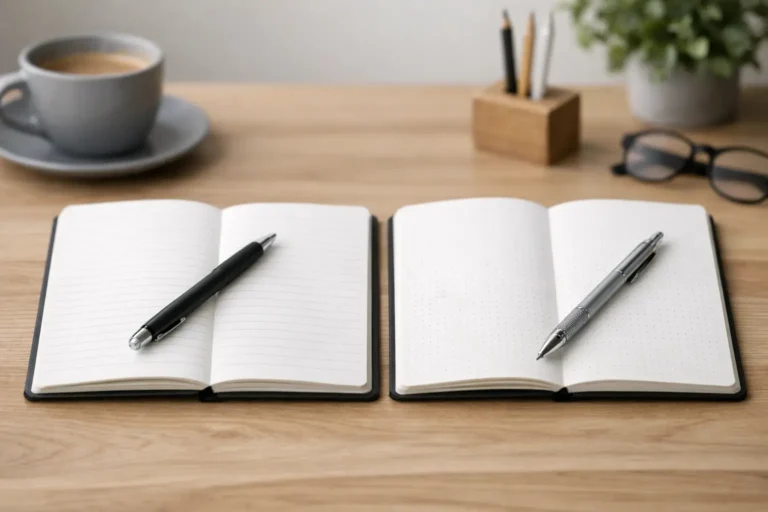
That blank first page can feel full of possibility – until you realize the paper format is fighting the way you think. The choice between lined versus dotted notebooks is not just about looks. It shapes how quickly you can capture a class lecture, plan a birthday party, map out your week, or finally turn a cheerful idea into a real list.
Lined versus dotted notebooks: the quick answer
Choose a lined notebook when words are the main event. The ruled lines give every sentence a natural home, so notes, journal entries, meeting minutes, and long to-do lists stay tidy without extra effort. If you like opening a notebook and getting straight to writing, lined pages are wonderfully low-maintenance.
Choose a dotted notebook when your pages need to do more than hold paragraphs. Tiny, evenly spaced dots create a subtle grid for calendars, habit trackers, sketches, tables, diagrams, and creative layouts. They are there when you need guidance and nearly disappear when you do not.
Neither choice is more organized, more creative, or more serious. It depends on what you want to make and how much structure helps you start. A notebook should feel like a helpful sidekick, not another set of rules.
Why lined pages are a reliable everyday favorite
Lined notebooks have earned their classic status. The horizontal rules keep handwriting level, make blocks of text easier to scan, and save you from drawing your own guidelines before every task. For students, busy parents, teachers, and anyone who takes plenty of written notes, that small convenience adds up quickly.
They are especially useful for journal writing. Whether you are recording a big life moment, writing a thank-you note draft, keeping a reading log, or clearing your head after a long day, lines give your thoughts a gentle rhythm. You can write quickly without worrying that your paragraphs will slope across the page.
At work, lined paper is often the most practical choice for meeting notes and action items. A page of words reads naturally from top to bottom, and it is easy to date the page, add a heading, and highlight the next thing you need to do. There is no setup required, which matters when an idea arrives between appointments or a teacher needs to jot down a classroom reminder.
Lined notebooks also suit younger writers who are still building confidence with handwriting. Clear spacing can make letters more consistent and pages less intimidating. For older students, they are a familiar fit for lecture notes, essay outlines, vocabulary lists, and study reflections.
The trade-off with lined paper
Lines can feel restrictive when your notes are a blend of words, arrows, drawings, and quick visual connections. You can absolutely make a chart or sketch in a lined notebook, but the rules may distract from the layout. If you regularly find yourself turning your notebook sideways, drawing boxes over the lines, or wishing for more room around your ideas, dotted paper may feel more natural.
What makes dotted notebooks so flexible
Dotted notebooks use small dots arranged in a grid, usually with enough space between them to guide writing and drawing without taking over the page. From a normal reading distance, they look much cleaner than graph paper. Up close, they offer surprisingly useful landmarks.
That balance makes dot grid pages popular for bullet journaling, but you do not need a perfectly color-coded planner to enjoy them. Use the dots to create a monthly calendar one week, a packing checklist the next, and a simple page of notes after that. There is no requirement to turn every spread into a social-media-ready masterpiece.
For creative thinkers, dots make it easier to combine formats on one page. You might write a short project brief on the left, sketch a display idea on the right, and add a small budget table at the bottom. Planning a celebration? Make a guest list, cake sketch, shopping checklist, and timeline together without switching notebooks.
Dotted pages are also handy for visual planning. Their faint grid helps with habit trackers, chore charts, meal plans, seating ideas, simple bar graphs, and travel itineraries. Students can use them for math work, science diagrams, mind maps, or flashcard layouts. Small-business owners may use them to outline packaging concepts, track orders, or brainstorm a product launch.
The trade-off with dot grid paper
Flexibility asks a little more of you. A dotted page does not automatically tell you where a paragraph begins or how far apart your rows should be. For a fast meeting or a long lecture, some people find that extra freedom slows them down. Dots can also feel too faint for writers who prefer strong visual guidance.
There is another honest consideration: dotted notebooks can invite overplanning. If setting up a weekly spread becomes a 45-minute art project when you only need three appointments and a grocery list, simple lined pages might serve you better. Creative expression is lovely. So is finishing the plan.
Match the notebook to the job, not the trend
The best notebook format often changes with the task. A lined notebook makes sense for a daily journal, school notes, work notes, writing projects, and correspondence drafts. It lets language take center stage.
A dotted notebook shines when you need flexible organization, visual thinking, or a mix of writing and design. It works beautifully for planners, project boards, personal goals, house projects, party planning, and creative hobbies. Its structure stays quiet until you call on it.
If you are buying a notebook as a gift, think about how the recipient spends their time. A friend who loves writing letters, documenting memories, or taking classes may appreciate lined pages. A list-maker with a colorful planner, an aspiring artist, or a friend planning a wedding or new baby might enjoy dots. The cover can bring the smile, but the page style is what makes the notebook useful long after the unwrapping.
Paper details matter as much as the pattern
Do not choose based on lines or dots alone. The best layout can still disappoint if the notebook is too small for your bag, too bulky for your desk, or made with paper that lets ink show through. Think about the pens you use most. Gel pens, fountain pens, markers, and highlighters can behave very differently on lightweight paper.
Page count matters, too. A slim notebook is easy to tuck into a tote, backpack, or desk drawer and is ideal for a single project. A thicker notebook gives long-term journals, school subjects, and big plans room to grow. Binding is worth considering as well: a notebook that lies flat is especially useful for sketching, planning, and writing across a full spread.
Cover design is not a trivial extra. A notebook you genuinely want to pick up gets used more often. Bright florals, sweet characters, bold patterns, funny sayings, and clean modern designs all give a practical tool a little personality. Gooji Paperie believes everyday stationery can be useful and joyfully expressive at the same time.
A simple way to decide before you buy
Picture the first three pages you will fill. If they are likely to be paragraphs, class notes, lists, or journal entries, go lined. If they will include a calendar, boxes, arrows, sketches, categories, or a custom tracker, go dotted.
Still torn? Choose based on the task that happens most often, not the occasional task you hope to start. You can draw a basic table on lined paper once in a while. You can write on dots, too. But your notebook should make your regular routine easier from page one.
Some stationery lovers keep both formats on hand, and that is not overdoing it. A lined notebook can hold the words you want to remember, while a dotted notebook can give shape to the plans that make those moments happen. Pick the pages that make you want to put pen to paper, then let the ideas get a little messy, colorful, and wonderfully yours.
