

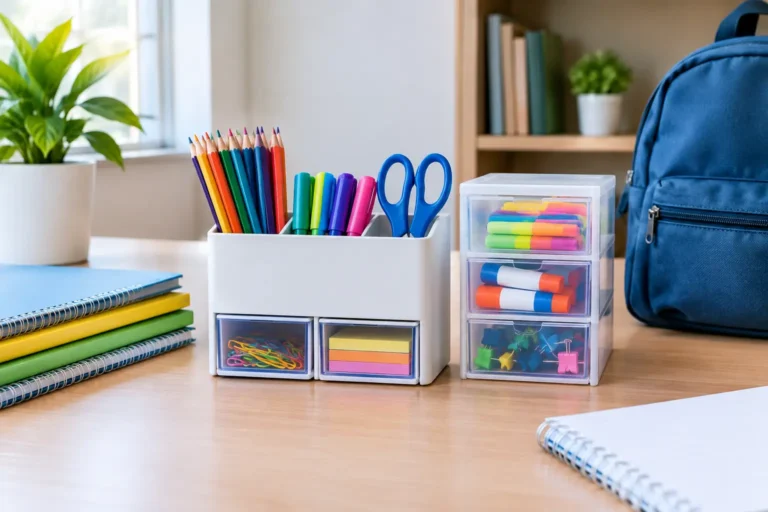
The kitchen counter starts innocently: one pencil, a permission slip, and a notebook with a bent corner. By Thursday, it is a colorful pile that somehow contains three glue sticks, no scissors, and a snack wrapper from last week. Learning how to organize school supplies is less about creating a picture-perfect study space and more about making busy school mornings and homework time feel easier.
The best system is one your child can actually use. It should be simple enough to reset in a few minutes, flexible enough for new projects, and cheerful enough that putting things away does not feel like a chore. Think clear categories, easy-to-reach storage, and a small routine that keeps the paper avalanche under control.
Start by Sorting Before You Buy Storage
It is tempting to start with matching bins and cute labels. First, gather every school supply from backpacks, drawers, the car, and that mystery basket by the door. Seeing it all in one place makes duplicates obvious and prevents buying another pack of markers when six unopened packs are already hiding behind the cereal boxes.
Sort everything into broad groups: writing tools, paper goods, art supplies, classroom extras, and tech or project materials. Keep the categories loose. A second grader does not need a museum-level filing system for crayons, while a middle schooler with multiple subjects may need separate sections for binders, folders, and index cards.
As you sort, toss dried-out markers, broken crayons, empty glue bottles, and papers that no longer matter. Test pens before returning them to the pile. This small edit makes the supplies that remain more useful, and it gives every item a better chance of finding a home.
Create School Supply Zones That Match Real Life
One giant supply drawer rarely stays organized for long. Instead, set up a few zones based on where supplies are used. The right number depends on your home and your student, but most families do well with four.
- The backpack zone holds daily essentials near the door: a pencil pouch, water bottle, library books, folders, and any forms that need to go back to school.
- The homework zone keeps pencils, erasers, scissors, a ruler, notebooks, and a charging cable close to the usual work surface.
- The creative zone contains markers, colored pencils, paints, glue, stickers, and other supplies that are used for projects or just-for-fun making.
- The refill zone stores extras such as loose-leaf paper, replacement pencils, unopened notebooks, and backup glue sticks.
This approach solves a common problem: supplies migrate because they are needed in different places. A child should not have to raid the craft cabinet for a pencil every evening, and you should not have to keep every backup item in the backpack. Daily supplies stay accessible; refills stay contained.
For younger kids, place the most-used items in low bins or cups they can reach independently. For teens, a desktop caddy, drawer organizer, or rolling cart can work well, especially if they move between a bedroom desk and a shared family table.
Give Every Item an Easy Home
The secret to how to organize school supplies without constant maintenance is to avoid overly specific storage. A bin labeled “blue pens” may look satisfying for a day. A bin labeled “writing tools” is much more likely to survive a real school week.
Use clear containers when possible, particularly for crayons, markers, and small supplies. Kids can see what is available without dumping every container onto the floor. Open-top bins are quick for everyday use, while lidded boxes are better for extras or messy craft materials.
Labels help, but they do not need to be fancy. Simple words work for older kids. For younger children, add a small drawing or color cue: a pencil image for writing tools, a paper icon for notebooks, or a star for art supplies. If several people share the same homework area, label one container for each child. That saves time and reduces the classic after-school debate over whose highlighter is whose.
A pencil pouch deserves special attention. It is the mini supply station that travels to school, tutoring, the library, and the dining table. Keep only useful daily basics inside: two sharpened pencils or pens, an eraser, a small ruler, and any class-specific item that is regularly needed. A stuffed pouch is hard to use, so leave the giant marker collection at home.
Set Up a Paper System That Does Not Fight You
Paper is usually the real clutter culprit. Worksheets, artwork, notices, and half-finished assignments can make an organized supply setup look messy in one afternoon.
Give incoming papers one temporary landing spot. A vertical file holder, wall pocket, or clearly labeled tray near the backpack zone works well. The goal is not to keep every paper forever. It is to stop important papers from disappearing under a stack of coloring pages.
For elementary school students, try three simple folders: “Bring Back,” “Keep at Home,” and “Finished.” For older students, subject folders or color-coded binders may be more useful. The trade-off is worth considering: more categories can support students with several classes, but too many labels can make a system harder to maintain. Start simple and add structure only when it solves a real problem.
Artwork needs its own plan, too. Display a few favorites on the fridge or a wall, then place the keepers in a large portfolio or memory box. Rotate the display instead of trying to preserve every single masterpiece in plain sight. It keeps the home feeling celebratory without turning every surface into a paper gallery.
Make Organization Part of the Weekly Rhythm
No storage solution can replace a reset routine. The good news is that it does not need to take long. Pick one predictable moment, such as Sunday afternoon or the evening before trash day, and spend five to ten minutes checking supplies together.
Sharpen pencils, remove stray wrappers from the backpack, return supplies to their zones, and scan for items that need replacing. Check the paper tray for permission slips or upcoming project notes. This is also a great time to restock the pencil pouch, rather than discovering an empty glue stick five minutes before bedtime.
Keep the reset light and practical. A playlist, a small snack, or a quick “what do you need for this week?” conversation can make it feel less like another household task. The goal is not perfection. The goal is fewer frantic searches when the school bus is due in six minutes.
Choose Supplies That Are Easy to Keep Together
A coordinated set of school supplies can make organization easier because similar sizes stack neatly and are easier to spot. But matching everything is optional. What matters more is choosing supplies your child enjoys using and can identify quickly.
Bright notebooks, playful stickers, colorful folders, and a pencil pouch with personality can help kids take ownership of their school setup. Gooji Paperie school supplies are designed to bring that little spark of self-expression to practical routines, whether your student loves bold color, sweet illustrations, or a notebook that makes homework feel slightly less serious.
Consider durability, too. A sturdy folder may be worth more than a cheap one that splits during the first week. Reusable labels can be smart for growing kids whose subjects change often. And if your home is short on space, choose supplies that nest together rather than buying large organizers that create more clutter than they solve.
Let the System Grow With Your Student
What works in September may need a refresh by January. New classes, bigger projects, and changing interests all affect how supplies get used. If a bin is constantly overflowing, it may need to be split into two categories. If a labeled drawer stays empty, that storage spot may simply be inconvenient.
Ask your child what is annoying about the current setup. Their answer may be wonderfully specific: the scissors are too high, the homework pencils keep vanishing, or the folder color is impossible to remember. Those small details are exactly what turn a nice-looking setup into one that works.
A well-organized school supply space does not need matching labels, a giant desk, or a flawless reset every week. It needs a place for the essentials, a place for the extras, and enough room for real school life to happen. When the right pencil is easy to find, the next assignment can start with confidence instead of a scavenger hunt.
